
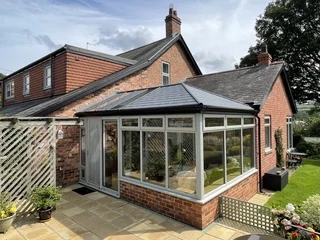
Type ‘does a conservatory add value’ into a search engine and you will get a tidy answer: somewhere between 5 and 7% on the price of your home, sometimes more. It is a reassuring number, but it is hard to trace and tells you nothing about the conservatory you have, or the one you are thinking of building.
The more useful answer is this. A conservatory adds value when a buyer can picture using it as a proper room in January as well as July. One that is freezing in winter, stifling in summer and leaking through the roof can do the opposite. So the answer depends less on a percentage and more on how the room is used, how it is built and, for an older conservatory, what sits on top of it.
Buyers pay for a room they will use
Buyers do not pay for glass. They pay for space they can live in. A conservatory that works as a dining room, a playroom or a quiet place for a desk changes how the whole house lives, and that is what a buyer weighs up. One that is only comfortable for a few weeks in spring and autumn is extra floor space that sounds good on the listing and then gets quietly discounted.
Temperature is usually what decides it. A polycarbonate roof loses heat quickly in winter and gains it quickly in summer, which is why so many conservatories sit unused through the colder months. If yours is one, the reasons a conservatory gets too cold to use, and the ways to fix it, are worth understanding before you decide anything else.
Build, upgrade or take it down
Building a new one
Build it because you will use it, and plan it as a room from the start: a roof that holds the heat, proper heating and a size in proportion to the house and garden. If you are also weighing up an orangery, look at the differences between a conservatory and an orangery: an orangery has more solid wall and roof and tends to feel more like part of the house. On value, both follow the same rule. The more it feels like a room, the more a buyer will treat it as one.
Upgrading the one you have
For an existing conservatory, the roof decides the answer. If the base and frame are sound and the problem is a roof that is cold, noisy or leaking, a conservatory roof replacement can turn a seasonal space into a room you use all year, which is the difference a buyer notices on a viewing.
At Hawthorns Windows we replace old glass and polycarbonate roofs with insulated, tiled warm roofs, which turn a conservatory into what we call a sunroom.
Should you replace the roof just before selling? It makes most sense if you will stay long enough to enjoy it, or if the roof is clearly failing and would put buyers off. A good new roof removes an obvious objection; a rushed job just before you list is less likely to pay its way, and a buyer’s solicitor may ask what approvals were in place.
Taking it down
Sometimes the honest answer is that the conservatory is past saving. A rotten base, a failing frame and a leaking roof look like a project to a buyer, and a reason to offer less. If you will not use it and cannot afford to put it right, removing it and making good the wall and garden can present the house better than a structure that is visibly struggling.
When a conservatory costs you value
A conservatory is more likely to count against a house when:
- it is too cold to use in winter or too hot in summer
- the roof leaks, has discoloured or roars in heavy rain
- it takes up most of a small garden
- it darkens the room behind it
- nobody can show what approvals were in place when it was built or altered
Do you need planning permission or building regulations?
For houses (not flats), many conservatories are built under permitted development, which means no planning application, provided they stay within the size and position limits that apply to home extensions in general. Building regulations are a separate question. The Planning Portal’s guidance on conservatoriessays a conservatory in England is usually exempt if it is single storey, built at ground level and under 30 square metres. It also needs to be separated from the house by external quality walls, doors or windows, and to have its own heating with separate controls. Its glazing and any fixed electrics must also meet building regulations. Any new structural opening between the house and the conservatory needs approval, even when the conservatory itself is exempt.
Changing the roof is worth checking too. A tiled conservatory roof is much heavier than glass or polycarbonate, so the frame and the base underneath need to be up to the job, and it is sensible to speak to your local building control team before work starts. The warm roofs we fit are built to be building regulation compliant.
So, is a conservatory worth it?
It is worth it if you will use it. A conservatory you live in all year makes daily life better and is far more likely to appeal when you come to sell.
When the roof is the problem, replacing it is what turns the room from a liability into an asset. Come and talk it through at one of our showrooms, or ask us for a warm roof quote for your conservatory.