
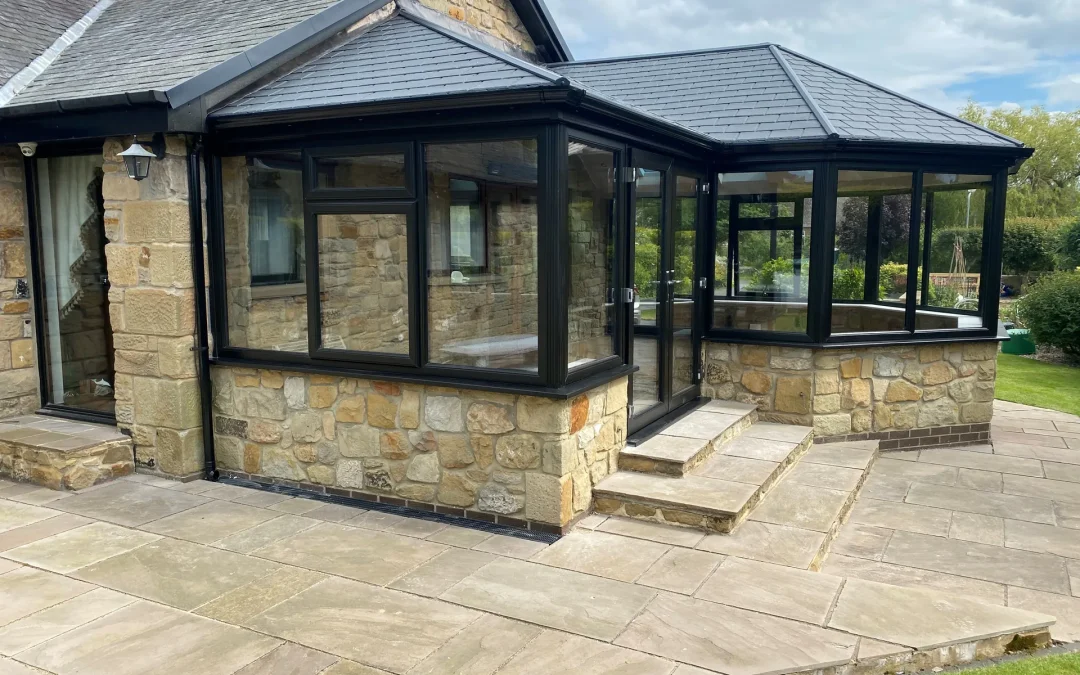
Do you need to replace all the windows in a conservatory, or only the ones that have failed? In most cases, replacing conservatory windows as a set gives a better result than addressing them individually, because the units were installed at the same time and tend to reach the end of their life together. Ordering replacement conservatory windows in one go also keeps the finish consistent across the room. There are exceptions, and the survey is where they get identified.
Homeowners across Newcastle and Northumberland usually come to this question after noticing one specific thing: a pane that has misted up, a room that has stopped holding its heat, or a frame that no longer closes cleanly. Glazing is one part of a wider picture, and our guide to conservatory refurbishment sets out where it sits alongside the roof and frames.
What tells you the glazing has gone
A sealed glazing unit holds an insulating gas between its panes. The seal around the perimeter keeps that gas in place, and it degrades with weather exposure over time.
Once it fails, moisture finds its way in. The visible sign is misting or a permanent haze between the panes that no amount of cleaning shifts. The less visible consequence is that the unit has stopped insulating, so the glass now radiates cold on a winter morning and traps heat on a July afternoon.
Water marks or pooling at the bottom edge of the glass mean the failure is well advanced, our guide to condensation between double glazing panes covers that specific failure in more detail.
When the frame is the real culprit
Glazing gets the blame for problems that belong to the frame.
Draughts around the opening edge usually point to a hardened gasket. Sticking sashes and handles that need force point to hinge wear or slight movement in the frame. A cold line along the join between frame and brickwork points to perished external sealant.
The distinction matters because it changes what the fix looks like. A conservatory with sound frames and three failed units is a different job from one where the frames have aged past their useful life alongside the glass.
Why we replace the whole unit
We install full window replacements. Swapping sealed units into existing frames leaves the weakest component in place, because the frame carries the gasket, the drainage channels and the fixing points.
Fitting a high-specification unit into a twenty-year-old frame means the glass improves and the seal around it does not. The draught that prompted the work in the first place is often still there afterwards.
What newer glazing changes
Modern units differ from those installed in the 1990s and 2000s in several ways that matter in a conservatory. Warm-edge spacer bars reduce the cold bridge around the perimeter. Low-emissivity coatings reflect heat back into the room in winter. Argon or krypton fills slow heat transfer across the cavity.
Replacement glazing has to meet the thermal standards set out in Approved Document L, which is why a modern unit performs to a different level than the one it replaces. The Glass and Glazing Federation also publishes homeowner guidance on what a replacement should deliver and what to ask an installer.
Solar control coatings are worth discussing for conservatories specifically, because the glazed area is large and often south or west facing. They reduce the heat coming in through summer without making the room feel dark. For homeowners whose main complaint is temperature, our piece on turning a cold conservatory into a usable room covers the wider picture.
Where the roof comes into it
Conservatory windows sit alongside a roof that usually has more influence on comfort than the glazing does. Replacing the windows in a conservatory with a polycarbonate roof improves matters at the walls and leaves the largest surface untouched.
Where both have aged, homeowners often combine the two. New glazing at the walls and a solid tiled, insulated warm roof overhead is the combination that changes how the room behaves year round.
What we assess during a survey
A survey establishes which parts have failed and which have life left. We look at each glazing unit, the condition of the gaskets and frames, the drainage, the seal to the brickwork, and how the room performs through the seasons.
From there we talk through what replacing the glazing would change, whether the frames need to go at the same time, and how the roof factors in. The investment depends on the number of openings and the specification, and we cover that during the visit.
If a pane has misted or the room has stopped holding its warmth, book a free survey with Hawthorns and we will go through what your conservatory needs. We have been installing across Newcastle and Northumberland since 1989.