
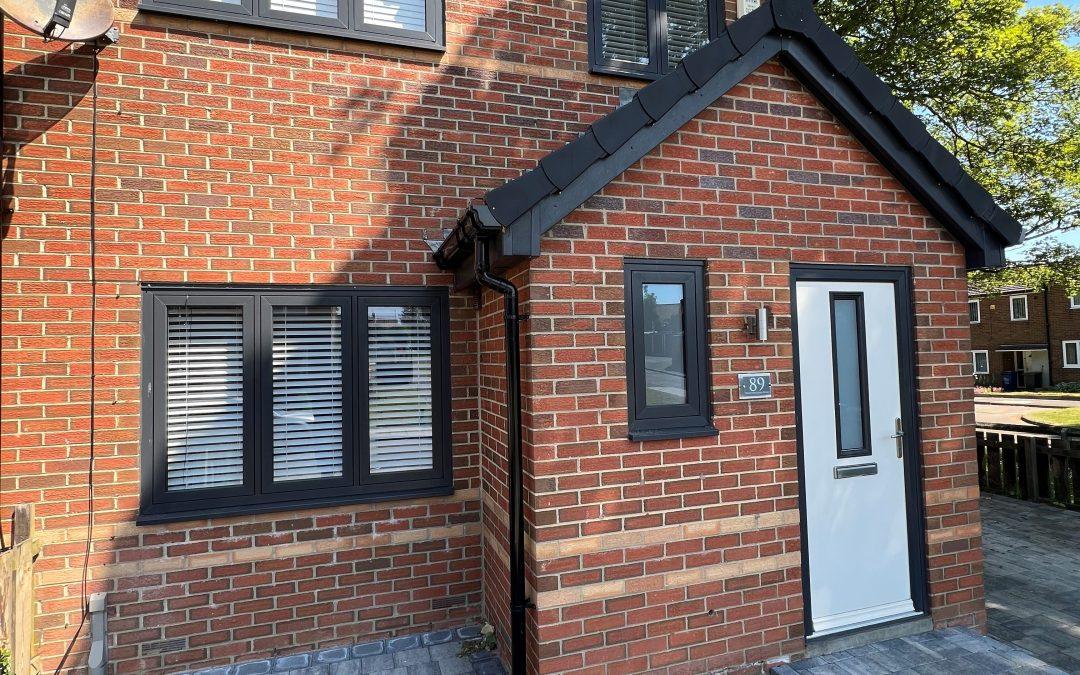
If you’re thinking about anthracite grey windows, you’ve probably already decided you don’t want plain white but aren’t sure how grey will actually look on your house. We’ve been fitting windows across Newcastle, Morpeth and Northumberland since 1989, and below is everything worth knowing before you commit.
Why anthracite grey became the default upgrade
The shift started around ten years ago, when RAL 7016 (the technical name for anthracite grey) moved from commercial and Scandinavian residential into mainstream UK housing. It filled a gap the market hadn’t: a neutral darker than silver, warmer than black, with enough depth to read as deliberate rather than accidental.
For North East homeowners, it solved a specific problem. White UPVC windows can wash out against the region’s red brick and sandstone, while black often feels heavy-handed on period properties. Anthracite lands in between. It draws a clean line around each opening without overwhelming the masonry.
Do anthracite grey windows date?
Window colour trends move slowly because frames stay in place for 20 to 30 years. The colour that dates first is usually the one that peaked quickly. Anthracite grey has had a long, steady rise rather than a sharp spike, which is typically what protects a colour’s longevity.
The closest comparison is natural woodgrain, which has been popular across UK housing for 40 years and still reads as unremarkable on old and new properties. Anthracite grey is following a similar path. Installations we fitted eight or nine years ago still look current today.
How anthracite grey pairs with different property types
Red brick 1920s to 1960s semis and terraces. The contrast is what sells it here. Grey frames define each opening cleanly and stop the elevation from going flat.
Sandstone and period stone. Anthracite works on Victorian and Edwardian sandstone if the proportions are right. Flush sash or vertical sliding sash profiles in grey look considered.
Bulkier casement profiles can overpower delicate stonework, so the frame style matters as much as the colour. Our guide to the main window styles and where each one suits is a sensible first read if you’re unsure.
For genuine period properties, our heritage window options for older homes are often a better route than standard casements. Render and new builds. This is where grey shows best. Light render with anthracite frames has become the default for most North East developers because it photographs well and ages slowly.
Pebbledash or varied render. Grey can fight with the visual noise of pebbledash. If the render is patchy or varied in tone, white frames often read cleaner.
Inside the house: dual colour explained
Most anthracite grey UPVC windows in the UK are specified as dual colour: grey exterior, white interior. This is deliberate. White interiors keep rooms feeling light, reflect more daylight and fit nearly every internal scheme.
You can order grey on both faces if you want the darker frame inside too. It suits loft conversions, industrial kitchens and any space where the frame is part of the design. For most rooms, the dual finish works better.
Do anthracite grey windows cost more than white?
Yes, slightly. Coloured foil frames sit above white as the base price, and the uplift is typically 10 to 20 percent depending on the profile and glazing spec. The difference narrows on higher-spec products because the frame cost is a smaller share of the total. The uplift is the same for most darker colours, not only grey. So if you’re comparing grey against black, or anthracite against a deep green, the cost is broadly similar. The decision comes down to what the house wants.
Matching the rest of the exterior
The easiest way to ruin anthracite grey windows is to fit them and leave everything else untouched. A matching anthracite or dark composite front door lifts the whole elevation, and grey roofline trims finish the job. Garage doors and gutters are the other small details that either pull the look together or expose the frames as a half-finished project.
You don’t have to do it all at once. Windows first, then doors and roofline over the next year or two, works fine. The colour match stays consistent across our standard foil range.
Is anthracite grey right for your home?
The colour suits more properties than not. The exceptions are small period cottages where painted timber still reads more appropriate, ornate Victorian villas where any strong frame colour competes with existing detail and rendered properties in poor condition where a lighter frame hides imperfections better.
For most Newcastle, Morpeth and Northumberland homes built between 1920 and today, anthracite grey is a safe upgrade that looks modern without shouting.
The best way to decide is to see anthracite grey against your own brick or render before you commit. Book a free home visit and one of our team will bring full anthracite samples to your door, talk you through the profile options and give you a fixed written quote in your own time. If you’d rather keep researching first, you can browse recent anthracite grey installations across Newcastle and Northumberland to see how the finish reads on properties like yours.